
The Hidden Costs of Reactive Security for Commercial Properties
Commercial property security budgets rarely account for the true cost of reacting after an incident has already happened. This post breaks down the hidden costs of reactive security, from theft and vandalism to liability exposure and lost staff hours, and shows how VIDISKY AI helps property teams shift to real time, proactive protection using the cameras they already have.
Table of contents
Most commercial property budgets account for the obvious security expenses: cameras, guards, alarm monitoring, and system upgrades. What often gets overlooked is the cost of finding out about a security incident after it has already happened.
A camera can capture a break in while it is happening. A guard may respond after receiving a call. A property manager may review footage the next morning to understand what went wrong. By then, the incident is over and the costs have already started to add up.
For property owners and managers, the real question is not whether a building has security cameras. It is whether that system can catch a threat while it is unfolding, or whether it is simply documenting losses for the insurance file.
What Counts as Reactive Security?
Reactive security describes any system built to respond to an incident after it is detected or reported, rather than while it is still developing.
Picture a typical commercial property: cameras at entrances, parking lots, loading docks, and interior hallways. They record around the clock, but there is rarely anyone actually watching the feeds live. When something goes wrong, the process usually runs like this:
- An incident happens.
- Someone notices, often well after the fact.
- Security gets a call or a report.
- Someone pulls the footage.
- The team investigates.
- Whatever action is taken happens well after the incident is over.
That workflow is useful for building a case after the fact. It does little to stop the incident from happening in the first place.
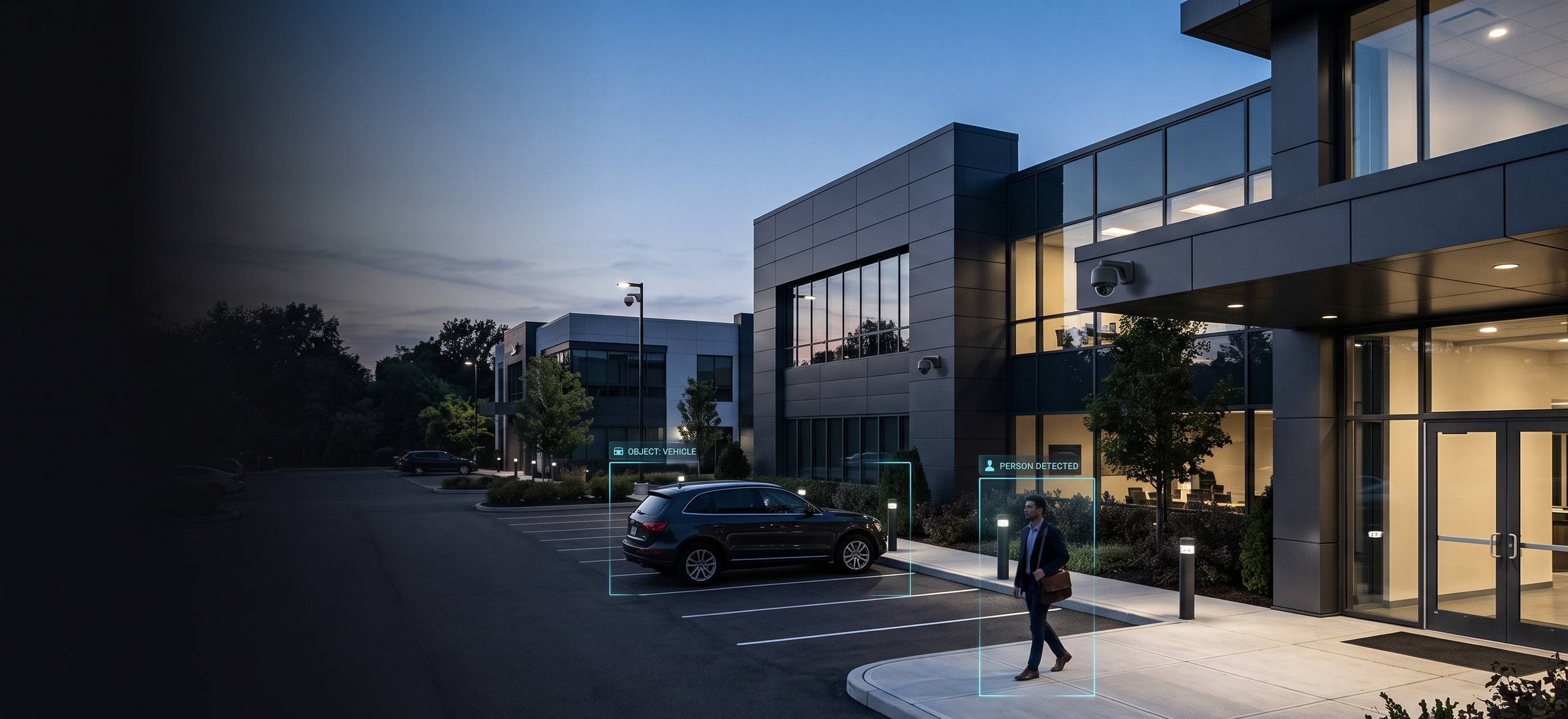
AI powered security works differently. Instead of counting on a person to catch something on a bank of monitors, the system continuously analyzes every camera feed, flags activity that looks like a genuine threat, and puts it in front of a human reviewer while the situation is still live.
That shift from reviewing footage after an incident to identifying activity in real time can fundamentally change how a property approaches security.
The Real Cost of Reactive Security for Commercial Properties
Security budgets are built around line items you can see coming: camera hardware, guard payroll, monitoring contracts, and maintenance. The costs that often hurt the most are the ones nobody budgets for because they only show up after an incident.
Here is where those hidden costs tend to come from.
1. Theft and Property Loss
Commercial properties hold a lot worth stealing: tools, electronics, inventory, vehicles, and equipment sitting in parking structures overnight. When a theft is discovered hours later, there is rarely a window left to do anything about it.
Footage can help build a police report. It does not get the property back, and it does not undo the disruption to whoever relied on what was taken.
A system built for proactive commercial property security can flag unauthorized access, unusual movement near restricted areas, or after hours activity as it happens, giving a human reviewer time to intervene before the theft is complete.
2. Property Damage and Vandalism
Vandalism looks like a minor line item until the repair invoices start piling up: broken doors, damaged lighting, graffiti, and damaged equipment.
The bigger issue is when it keeps happening in the same location.
A parking garage that gets damaged overnight, week after week, does not simply have a repair problem. It may have a monitoring and response problem.
Patching the damage after every incident treats the symptom, not the pattern. Identifying the activity while it is happening and having someone able to intervene can help break that cycle.
3. Slow Response Times
In security, response time can determine whether an incident is contained quickly or results in greater property damage, disruption, or loss.
Someone loitering near a restricted entrance is not necessarily a threat. Someone actively trying to force that entrance is. Traditional systems can create delays because someone has to notice what is happening, interpret the situation, and decide what to do.
VIDISKY AI closes that gap by pairing continuous AI detection with human analyst review, designed to enable rapid, human verified response when a genuine threat is flagged.
That can mean the difference between catching something in progress and finding out about it the next morning.
4. Rising Security Labor Costs
The instinct when security gaps appear is often to hire more people.
But commercial properties are genuinely difficult to monitor manually. A property with dozens of cameras across multiple buildings, entrances, and parking areas is not something one person can watch continuously. Security personnel may already be dividing their attention between patrols, access control, and visitor management.
Adding headcount gets expensive quickly, while leaving the gap unresolved creates its own risks.
AI powered monitoring does not replace a security team. It extends what the team already has by filtering activity and bringing events that require attention to the right people.
5. Tenant and Employee Complaints
Not every security problem shows up as an incident report.
A lot of them show up as complaints.
A tenant may not feel safe walking to their car after dark. An employee may feel uncomfortable entering the building early in the morning. A visitor may notice that the lighting around a parking area is consistently poor.
Any single complaint may seem minor. A pattern of complaints can affect how a property is perceived and eventually influence tenant satisfaction and retention.
Continuous AI powered coverage across the areas people already worry about can help property teams identify and respond to security concerns more effectively.
6. Liability and Insurance Exposure
Every incident, whether it involves unauthorized access, an injury, theft, or an unsafe condition, can carry liability risk.
Having footage is useful, but footage alone does not demonstrate that a property had an effective response. It shows that the camera was recording.
A proactive security operation creates a stronger record of what happened: what was detected, how quickly it was verified, what response was triggered, and how the incident was resolved.
That documentation can be valuable when an incident needs to be investigated or a claim needs to be addressed.
7. Operational Disruption
The real cost of an incident rarely ends with the incident itself.
A break in can involve property management, police reports, repair crews, tenant notifications, and insurance paperwork.
A damaged loading dock can disrupt deliveries. A vandalized entrance can affect how people access the building.
These downstream costs can quickly outweigh the original loss.
Stopping or interrupting an incident while it is happening can help reduce the operational impact that comes afterward.
8. Hours Spent Reviewing Footage
Cameras generate a significant amount of video, and when something happens, someone has to find the relevant footage.
That means estimating a timeframe, locating the right camera, reviewing hours of video, and potentially tracking a person or vehicle across multiple camera angles.
AI powered video analysis can reduce much of that burden by surfacing relevant events and footage automatically instead of requiring a person to manually search through hours of recordings.
That turns stored video from a passive archive into a more useful security resource.
Why Cameras Alone Were Never Going to Solve This
Traditional CCTV still matters. The problem is not the camera. It is what happens after the camera captures something.
A camera can record an intruder walking through a restricted door. It can capture someone damaging a vehicle in a parking lot. None of that helps with prevention unless someone or something is actually identifying the activity while it is happening.
That gap is why more commercial property teams are moving from passive surveillance toward proactive commercial property security.
The cameras were not necessarily the problem. The challenge was getting more value from the infrastructure already in place.
What Proactive Commercial Property Security Actually Looks Like
Moving from reactive to proactive security for commercial properties changes the workflow from record and investigate to detect, verify, respond, and document.
Detect. AI continuously analyzes live feeds and flags activity that could represent a threat.
Verify. A trained human analyst reviews the flagged event to confirm whether it is a genuine threat and helps filter out false alarms before unnecessary escalation.
Respond. Once a threat is confirmed, the system can trigger the property's response protocol, whether that means a live voice down warning telling the person on camera they are being monitored, a strobe light activation, or a direct alert to security personnel and property management.
Document. The event and the response can be logged, creating a record for reporting and future investigation.
That loop turns a camera network from a recording system into an active security operation.
Do You Need to Replace Your Existing Security Cameras?
For many commercial properties, improving security does not necessarily mean replacing the existing camera infrastructure.
A camera agnostic AI security platform can connect with existing IP cameras and add intelligent monitoring capabilities on top of the current system.
VIDISKY AI is built around this approach. It works with the infrastructure a property already has and adds AI powered monitoring, human verification, active deterrence, and security intelligence to existing camera feeds.
This allows property teams to improve their security operations without starting with a complete hardware replacement.
License Plate Recognition for Parking and Property Access
Parking areas are another important part of commercial property security.
License Plate Recognition (LPR) and License Plate Number Recognition (LPNR) can help property teams identify and track vehicles entering and leaving monitored areas.
License plate reading can provide additional visibility into vehicle activity across parking lots, parking garages, loading areas, and controlled entry points.
For example, LPR can help security teams identify vehicles entering a property, investigate unauthorized vehicles, and provide useful information when reviewing a security incident.
When combined with other AI video analytics, license plate recognition can become another layer of visibility for properties that need to monitor both people and vehicles.
For commercial properties with existing IP cameras, adding intelligent LPR capabilities can provide additional security intelligence without requiring a complete camera replacement.
How VIDISKY AI Closes the Gap
VIDISKY AI gives commercial property teams a straightforward way to move from reactive to proactive security without adding unnecessary complexity to their operations.
The platform combines AI powered detection, continuous monitoring, human verification, active deterrence, license plate analytics, and automatic documentation into one workflow.
Instead of asking property staff to watch camera feeds themselves, VIDISKY AI analyzes every feed continuously and surfaces the events that actually matter.
A trained remote analyst reviews each detection before anything is escalated, helping property teams avoid chasing false alarms.
Once a threat is confirmed, VIDISKY AI can trigger active deterrence in real time through live voice down warnings or strobe lighting, enabling a rapid response while the event is still unfolding.
For a property team managing dozens of cameras across multiple buildings, parking areas, entrances, and loading docks, that can be the difference between a security system that documents what happened and one that actively helps respond to what is happening.
Is Your Property More Reactive Than You Think?
Ask your security or property management team:
- Are the cameras actively monitored around the clock, or are they primarily recording?
- How long does it typically take to detect and verify an incident?
- Are the same incidents happening in the same locations repeatedly?
- How often does your team find out about something after it is already over?
- How many staff hours go into manually reviewing footage each month?
- Is there real coverage across parking areas, entrances, and loading docks?
- Could your existing cameras support AI powered monitoring?
- Can your security system identify vehicles through license plate recognition?
- Is every incident documented consistently, regardless of who is on shift?
If several of those answers are uncertain, the issue may not be a lack of equipment. It may be that the existing security operation is still built primarily to react.
The Bottom Line: Prevention Costs Less Than Cleanup
The real cost of commercial property security is not limited to cameras, guards, and monitoring contracts.
It also includes what happens when those systems identify a problem too late to do anything about it.
Theft, vandalism, complaints, liability exposure, operational disruption, and lost staff hours can all add up under a reactive model.
That does not make traditional security obsolete. Cameras, guards, access control, and other security measures remain important parts of a strong security strategy.
The opportunity is to make those systems work together more intelligently instead of relying on them simply to record and wait for someone to notice.
Make Your Commercial Property Security Proactive
Your cameras are already watching your property.
The real question is whether they are doing anything the moment they spot a potential threat.
VIDISKY AI turns the camera infrastructure you already have into an AI powered security operation with real time detection, human verified monitoring, active deterrence, and license plate analytics.
Ready to move from reactive to proactive commercial property security? See how VIDISKY AI can help turn your existing cameras into an intelligent security operation.
Request a Demo
Related Blogs
Thought Leadership
August 27, 2026
How to Increase Property NOI With Smarter Security
Rent growth and expense cuts aren't the only levers for property NOI. This guide breaks down how AI-powered security reduces preventable losses, frees up staff time, and protects tenant retention, and how VIDISKY AI helps property owners put that strategy into practice using the cameras they already have.
How to Increase Property NOI With Smarter Security
August 27, 2026
Thought Leadership
August 20, 2026
10 Signs Your Property Needs a Security System Upgrade
Grainy cameras, slow response times, and repeat incidents are more than minor annoyances. They can be signs that your property's security system is no longer keeping up. Here are 10 warning signs that it may be time for a security upgrade and what to look for in a modern, AI-powered system.
10 Signs Your Property Needs a Security System Upgrade
August 20, 2026
Thought Leadership

July 7, 2026
How to Improve Parking Lot Security at Apartment Communities
From vehicle theft to trespassing and late-night incidents, unmonitored lots create real risks for residents and real liability for property managers. This guide explores the most effective, AI-powered strategies to transform your parking areas into monitored, secure, and legally defensible spaces.
How to Improve Parking Lot Security at Apartment Communities
July 7, 2026